

Imagine a country without borders. There are no fences, no restrictions, no warning signs. Anyone can cruise through, set up camp and exploit its natural resources. If a land as this existed it would likely be trashed in a few years. No real country would allow this to happen yet we – people – permit anyone into our space to waste our time and energy. We allow others to push us around, use us, abuse us and “piss on our flowers” whenever they feel like it. Have you ever pondered why we do this ourselves? Why don’t we we have our boundaries?
Actually, we all have limits. They are those tipping points that send us over the cliff into an ocean of mental agony. Problem is, most people suffer because they have not defined their boundaries and are not even aware of them.
Historically boundaries have been very clear – you can’t just march into my village, eat my buffalo jerky, squat in my rice storage shed, and take my wife to your cave for a night. If any of these boundaries were overstepped, you can bet someone’s nut sack was being hung on the branch of a ficus tree the next morning.
Nowadays these same “threats” are still there. Some are more intricate, some are more subtle and others are just blurred outlines. You may feel your boundaries violated in a variety of ways: someone spreads divisive rumors, publicly flirts with your partner, diminishes your social status, does not respect your privacy or personal property, make decisions on your behalf without consulting, makes their problems your problems, asks you to do things that they can easily do on their own (or vice versa), gets physical in a verbal argument, etc.
Relationship between Boundaries and Anger Management
Even though the threats have evolved, our instinct to respond to them remains just as powerful as in the old ages. When someone “crosses our boundaries” we deal with it in one of the three ways:
- We immediately unleash a fury of verbal insults to “put them back in their place;” or
- We bite our tongue in order to avoid a scene and patiently wait till we can let it all rip when the party is over; or
- We stuff it all inside in order to not expose our vulnerability and give them a cold treatment; expecting them to figure out why we have a stiff lower lip.
Either way, the frustration of lack of respect for your boundaries simmers inside and builds steam, pressure cooking your internal organs with discontent and misery. It can feel as if someone robbed you of your power and dignity. Heck, you even willfully handed it over to them. Recognize the pattern? No wonder this is a spicy recipe for boundless frustration and anger.
Why People Do Not Set Boundaries?
- Fear of confrontation – we’d rather cross the street then bump into an old nemesis walking towards us on a busy boulevard. Most people would do anything to avoid even a slightly uncomfortable situation. “Oh man, I can’t believe he’s acting like this again, but if I mention something then he’ll become defensive and we’ll get into an argument, I’d rather just not say anything at all.”
- Fear of disappointing people – you might have built your image around being a perfectionist or you maybe naturally inclined to please people. Either way, these are noble character traits but a feeling of letting someone down could be your biggest nightmare. “There’s no way I can finish this in time but she wants this tomorrow. I’ve always worked fast; she’s going to wonder what happened… Oh well, I’ll just work through the night.”
- Fear of not being liked by others – believing that when you say NO to someone, they will have a strong reaction and not like you anymore. This is also tied to the fear of abandonment – being casted out of the tribe into a cold, lonely forest to live with the wolves. “What if they all go to a party and don’t invite me because I didn’t help them?”
- Self-defeatist mindset – the beliefs that other people’s needs and opinions are more important than your own. “I don’t deserve this,” “It’s not worth it,” “I never win anything,” “Others know better than I do…”
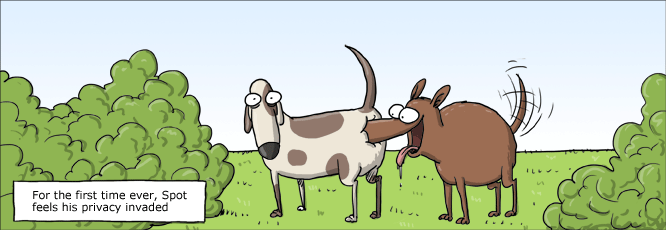
Five Reasons You should Not Live without Your Personal Boundaries
- Believing your assertiveness hurts another person can keep you from meeting your own physical and emotional needs. As a result, you may feel hurt, anxious, and bitter about life.
- You will find that none of your above fears will materialize if you assert your boundaries kindly and firmly. In fact, one of the “side effects” of boundary setting is improved relationships. Clear boundaries and a strong set of values always command more respect. (In our household we have an agreement to never argue in front of the baby – this is an absolute taboo.)
- It’s OK to disappoint people. By “disappoint” I mean – not to please them all the time, especially if it doesn’t truly benefit them long term. You will also notice that most people will get over their disappointment very quickly.
- If you don’t set and affirm your boundaries, other people will do it for you. Its not that they don’t respect you, they just test how much they can get away with for their own benefit.
- If you clearly know your boundaries you will take more steps to protect your dignity.
- You may have people in your life that manipulate you and exert their control over you without even you being aware of it. Maybe you have even turned away from your authentic identity and morphed into a person that your partner wants you to be.
[stextbox id=”info”]Setting personal boundaries is a vital people’s skill and an awesome anger management technique because it allows you stand up for your rights and take back the control that was taken away from you.[/stextbox]
The Do’s, Don’ts and How to’s of Effective Boundary Setting
Effective boundary setting can be as simple as saying “NO” but it requires a bit of finesse. To be most effective, it has to be done at the right moment and with the right tone. Below are a few guide points that maybe helpful:
- Don’t have so many personal boundaries that one would need a map to navigate this maze.
- Do be clear as to where your boundaries lay. Be it work, family, relationships, you have got to be very precise as to what your boundaries are and what behavior you are willing to put up with.
- Don’t make boundaries like the Great Wall of China. If they are too big or unreasonable they maybe impossible to respect.
- Do strategically structure your boundaries so that they can prevent a conflict but not in the way that it blocks communication.
- Don’t make your boundaries too selfish and insensitive to the basic needs of others.
- Do make sure your boundaries respect your ‘neighbor’s rights. A good litmus test would be a question whether most of your impartial friends would find this boundary as fair.
- Don’t make it sound like a complaint: “I don’t like this, or I don’t like that, I’m afraid of this or I hate when you do this…”
- Do be assertive, state it as a matter of fact and explain your motivation: “This behavior is hurtful and insults my dignity. I kindly ask not to be treated this way; I will not tolerate it.”
“In the middle of difficulty lies opportunity – Albert Einstein.
[stextbox id=”info”]There will be moments when someone has blatant disregard for your boundaries; especially people closest to you. They may even feel threatened by your newly discovered self-empowerment. This is where you have to be strong as a Spartan. If your antagonist realizes that breaking your boundary upsets you he may try doing that every time he feels like exerting his power over you. However, don’t become upset and defensive. It would be like handing an axe to a madman. Stay cool and collected, kind of like “OK you sucker, I know where you want to take me with this but I’m not going there.” Breathe deep into your belly to ease the tension and hang on! Go into “doctor-patient” mode. He may try another time or two. It’s very important not to allow him to latch on to breaking your boundary as your hurting point. Eventually, he will have no choice but to respect it.[/stextbox]
Enforcement
Borders of the country are only as solid as the border patrol that’s guarding them. Be courteously persistent protecting your boundaries and always gently remind people when they have crossed them. Be vigilant and take pre-emptive action when possible. If you see the “enemy” approaching, it is always easier the issue a warning shot than to engage into a full-on confrontation at the border line.
Your Life is in Your Hands
Setting personal boundaries is a powerful measure you can take to contain your own anger and improve your relationships. Being assertive does not dismiss or ignore the needs of others. On the contrary – it defines your space in the social environment and establishes an example of healthy set of values for everyone around you. When you do this, you should find yourself with a new sense of self-empowerment and having more control over your life as a whole. I wish you courage and success.
 P.S. If you like the idea of setting your boundaries and want to learn more, check out this excellently reviewed book on Amazon called Boundaries: When to Say YES, When to Say NO, To Take Control of Your Life
 5 Uncommon Rules for Fighting Fair and Winning, Every Single Time
 How to Respond to Verbal Abuse When You Hate Fighting
 How to Avoid the World on a Short Fuse Day
He never wants to talk after downloading all his bitterness and abuses to me. Should initiate the talk or give him space. He goes to drink in order to have the guts. He never ever admits his shortcoming.
Hi Catelinah, its true that he won’t talk after verbally abusing you. A person as such feels terrible inside for acting like this but they won’t admit it and will go on sulking and blaming their feelings on others. Drinking of course numbs that feeling so it only makes sense. I don’t know your situation fully so its hard to give advice but please see if you can use any of it from this article. Much courage and patience to you.
I think here would be my boundaries
1. Never fight in front of the kids. NEVER! Show by eye gestures that we shall dicuss it later in privacy. Make sure your partner agrees and complies to it 100%.
2. If your partner says hurtful things, tell them “this is hurtful and it ruins my dignity and self-esteem. Tell them you dont want this demeaning behavior from them again”. If you cannot say it right away, make sure to WRITE it on a piece of paper and hand it over, or email it. Don’t let it slide by, as it will only encourage them to repeat that behaviour. Repeat to yourself that you are person of high self esteem and dignity.
cheers
Constantly guarding your boundaries is very important. Stay vigilant
I think you have gotten a lot of great things out here, but missed some important ones.
Boundaries are something you choose – they are something you have. It is or is not okay with you for someone to do x. This is because you hold the value of y. This is your internal reaction. And you don’t get a choice in your own navigational system.
What you do get is a choice in how you react.
You can choose:
A. To examine the reaction and see if it is still appropriate: “I don’t like it that that Steve uses this phrase because Martha used to use it with me and it was a sign of disrespect. Martha means it as a term of endearment. I am not willing to bring baggage from one relationship to another, so I’m going to do self-work.
(I think this might be what you are trying to get at in terms of not erecting a Wall of China with unreasonable boundaries: be willing to do your own self-work first)
OR:
I don’t like it when this expression is used because I interpret it as demeaning. I’m going to share that with Martha. She can make get choice. And then I can act according to my personal boundaries. Knowing there is no right or wrong, I can decide A. That being with Martha is worth being triggered, knowing it’s not intentional, because I’m okay with non-intentionality, or B. I will speak up and work on it with her, because I believe in every relationship having a chance to process stuff, or C. I will adjust my closeness with Martha, because logical or not, her behavior bothers me, and we don’t fit together right now, and I value comfort and ease in relationships. or D. I need the kind of relationships where we both work for each other’s comfort, and knowing how big a trigger this is for me, I will need to restrict my relationships to ones that people consider me and can adjust enough to avoid it.
Hi Hamos, I feel we’re talking semantics here. Whether we “choose” our boundaries or we “have” them, what matters is what they’re designed to do and whether they can be enforced. In our case, those boundaries are a red line which, when crossed, trigger an alarm and response. They are there to deter the tress-passer. Now, when alarms go off, do all tress passers suddenly turn around and jet? Not really but in either case, the alarm will make him uncomfortable with his further actions and might even deter him from coming back.
I found this article today December 2019, maybe a little late for a response? Just the same, I found this article to be a refreshing read. Boundaries are so important and empowering. Thanks!
This is a great article. I am curious if there is a distinction between arguing in front of your kids vs having a discussion where emotions are OK. I ask because it’s actually helpful for kids to see their parents have an emotional discussion, and resolve it with love. Or, end the discussion with love.
Sounds you like know the answer. 😉 Modeling is way more effective than preaching.
Let me clarify. What I mean by having an emotional discussion and ending it with love, it requires a significant amount of emotional awareness on the parent’s end, of validating emotions and providing space for the other to express. Dr. Gottman shares and teaches these healthy techniques. Gottman.com
So when parents have a handle on their emotional expression and awareness it can model healthy behavior for children. When they don’t, anything else is modeling unhealthy emotional expression.